Scaffolding Parts: A Comprehensive Guide (Updated 01/22/2026)
Standards, ledgers, and transoms are fundamental components, forming the structure and transferring weight. Various systems, like Layher, utilize adjustment plates and differing standard lengths.
Scaffolding, often an overlooked element in construction, is fundamentally crucial – enabling projects from the Great Wall of China to the Sistine Chapel’s frescoes. These temporary structures provide safe access and support for workers and materials during building, repair, or maintenance. Understanding the core components is paramount for safety and efficiency.
Systems range from traditional wood pole scaffolding to modern, engineered solutions like Layher. Key elements include standards (uprights), ledgers (horizontal supports), and transoms (cross braces). Different types, such as single frame, double frame, tube and coupler, and fabricated frame, cater to diverse project needs. A scaffold’s load path – how weight is transferred to the ground – is a critical consideration. Proper installation, guided by a detailed scaffolding inspection checklist, ensures stability and prevents accidents. Access devices like ladders and towers complement scaffolding systems.
Types of Scaffolding

Scaffolding isn’t one-size-fits-all; various types address specific project demands. Single frame scaffolding relies on a single supporting frame, utilizing the structure itself for additional stability. Conversely, double frame (independent) scaffolding stands entirely on its own, requiring no structural support. Traditional wood pole scaffolding, while still used, is less common due to labor intensity.
Tube and coupler scaffolding offers versatility, assembled using tubes and couplers, while fabricated frame scaffolding provides quicker erection with pre-assembled frames. Beyond these, specialized systems like Layher offer modular components for complex geometries. Each type utilizes core components – standards, ledgers, and transoms – but their arrangement and connection methods differ. Selecting the appropriate scaffolding type depends on load requirements, height, site access, and safety considerations, always referencing material calculation sheets.
Single Frame Scaffolding
Single frame scaffolding distinguishes itself by leaning on a building’s structure for support on one side, reducing the need for a fully independent frame. This system utilizes standards (uprights) connected by ledgers (horizontal members) and transoms (cross braces) on the supported side, while the opposite side relies on the building’s facade.
It’s crucial to ensure the structure can bear the imposed loads. Proper tying and securing to the building are paramount for stability. While efficient for certain applications, single frame scaffolding requires careful assessment of the building’s suitability and adherence to strict safety protocols. Components like scaffolding clamps are vital for secure connections. This method is often favored for projects where access to a wall is needed for repairs or construction, but detailed planning is essential.
Double Frame Scaffolding (Independent Scaffolding)
Double frame scaffolding, also known as independent scaffolding, stands entirely on its own, requiring no support from the building structure. This is achieved through two rows of standards (uprights) connected by ledgers and transoms, creating a self-supporting tower. Base plates and scaffolding jacks are crucial for leveling and stability on uneven ground.
This system offers greater flexibility and is ideal when the building facade cannot support additional loads. Secure connections are made using scaffolding clamps, ensuring a rigid and safe structure. Independent scaffolding is frequently used for exterior work where a complete, unobstructed access is needed. Regular inspection, following a scaffolding inspection checklist, is vital to maintain its integrity and prevent accidents. It’s a versatile solution, but requires a larger footprint than single frame systems.
Wood Pole Scaffolding
Wood pole scaffolding, a traditional method, utilizes wooden poles lashed together to create a supporting structure. Standards, typically long wooden poles, are the vertical supports, while ledgers – horizontal poles – connect them for stability. Diagonal bracing, using additional poles, forms transoms, enhancing rigidity and preventing sway.

This system requires skilled labor for safe erection and dismantling, as proper lashing and securing are paramount. While cost-effective in some regions, it’s less adaptable than modern systems. Base plates, often wooden, distribute the load to the ground. Regular inspection is crucial, checking for damaged or weakened poles. Though historically significant – think of the Great Wall of China – wood pole scaffolding is less common in contemporary construction due to safety concerns and the availability of more efficient alternatives.

Tube and Coupler Scaffolding
Tube and coupler scaffolding, also known as traditional scaffolding, is incredibly versatile. It consists of steel or aluminum tubes connected by couplers – clamps that secure the tubes together. Standards (vertical tubes) form the uprights, while ledgers (horizontal tubes) provide lateral support. Diagonal braces, connected with couplers, create a rigid structure.
This system allows for complex configurations, adapting to irregular shapes and heights. Different types of couplers exist for various connections. Base plates distribute the load, and transoms support working platforms. Skilled erectors are essential for safe assembly, ensuring correct coupler tightening and bracing. While labor-intensive, tube and coupler scaffolding remains popular for its flexibility and cost-effectiveness, particularly for restoration projects or where access is challenging.
Fabricated Frame Scaffolding
Fabricated frame scaffolding, often called frame scaffolding, utilizes pre-assembled frames typically made of steel or aluminum. These frames consist of standards (uprights) connected by ledgers (horizontal members) and braces for stability. Platforms or decks are then placed within the frames to create working surfaces.
This system is known for its quick and easy assembly, requiring less skilled labor compared to tube and coupler scaffolding. Couplers or spigots connect frames side-by-side and in height. Base plates provide a stable foundation, and guardrails enhance safety. Fabricated frames are ideal for straightforward construction tasks and offer a good balance between speed, cost, and safety. However, their adaptability is limited compared to more flexible systems.
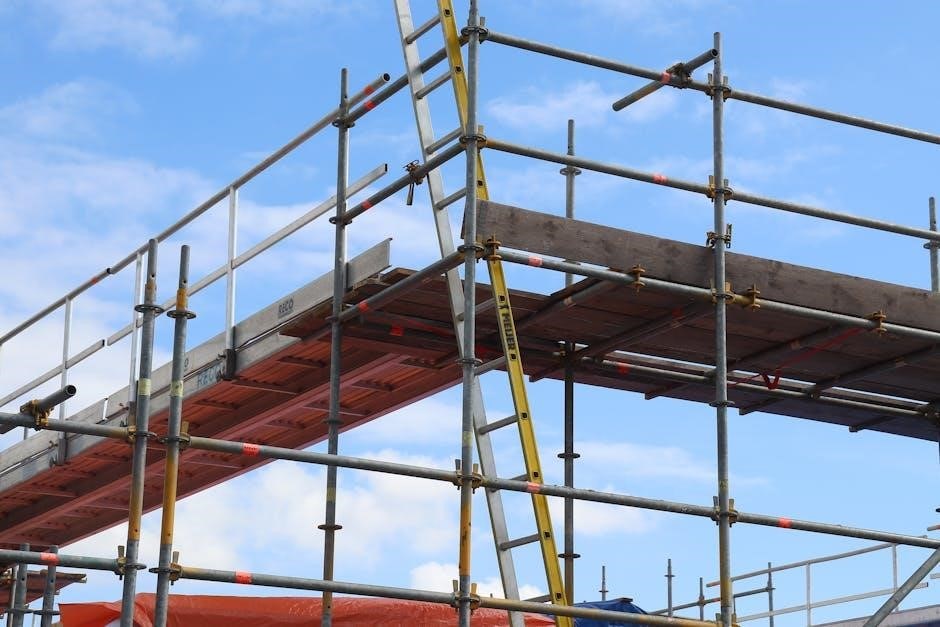
Core Scaffolding Components
Standards provide vertical support, ledgers offer horizontal stability, and transoms distribute weight effectively. These key elements form the foundational structure of any scaffolding system.
Standards (Uprights)
Standards, also known as uprights, are the crucial vertical members forming the scaffolding’s primary support. They directly transfer the entire load to the foundation, demanding robust construction and secure footing. These are typically manufactured from steel or engineered wood, designed to withstand substantial compressive forces.
Different scaffolding systems employ varying standard designs; Layher systems, for instance, feature standards of diverse lengths to accommodate varying heights. Proper installation is paramount – standards must be plumb, securely braced, and rest on stable base plates or adjustment plates. Regular inspection for damage, corrosion, or deformation is essential to maintain structural integrity. The spacing between standards is dictated by the scaffold’s design and the anticipated load, ensuring a safe and stable working platform. Without sound standards, the entire scaffolding structure is compromised.
Ledgers (Horizontal Members)
Ledgers are the horizontal members connecting standards, providing lateral stability and supporting the working platforms. They distribute loads from the platforms to the standards, playing a vital role in the scaffolding’s overall strength. Typically constructed from steel tubing or timber, ledgers must be securely fastened to the standards using appropriate couplings or clamps.
Layher systems utilize specifically designed ledgers for optimal integration. Proper ledger spacing is critical, dictated by the scaffold’s design and load requirements. Ledgers must be level and adequately braced to prevent racking or deformation. Regular inspection should focus on the integrity of the connections and the ledger material itself, checking for bends, corrosion, or damage. A properly installed ledger system is fundamental to a safe and stable scaffolding structure, ensuring a secure working environment.

Transoms (Cross Braces)
Transoms, also known as cross braces, are essential horizontal members that connect ledger frames, providing crucial stability and preventing swaying or collapse. They form a rigid structure, distributing loads and resisting lateral forces. Typically spanning between ledger frames, transoms are secured using fixed or swivel couplers, ensuring a tight and reliable connection.
Effective transom placement is vital; they should be installed at regular intervals as per the scaffold design. Proper bracing significantly reduces the risk of racking, a dangerous deformation that can compromise the entire structure. Inspection of transoms should focus on the security of the connections and the integrity of the bracing material, looking for any signs of damage or loosening. Transoms are a key component in maintaining a safe and structurally sound scaffolding system.

Layher Scaffolding System Components
Layher systems feature adjustment plates & base collars, varied length standards, and robust ledgers, creating adaptable and safe scaffolding solutions for diverse projects.
Adjustment Plates & Base Collars
Adjustment plates and base collars are critical Layher system components, ensuring precise leveling and stability on uneven ground. These components facilitate micro-adjustments, compensating for surface irregularities and guaranteeing a perfectly plumb scaffold structure. Base collars distribute the load effectively, preventing ground settlement and enhancing overall safety.
The use of adjustment plates allows for quick and easy height modifications, streamlining the erection process and adapting to changing site conditions. They work in conjunction with Layher standards to create a secure foundation. Proper installation of these elements is paramount, as they directly impact the scaffold’s load-bearing capacity and stability. Regular inspection of adjustment plates and base collars is essential to identify any signs of wear, damage, or loosening, maintaining a safe working environment.
Layher Standards (Various Lengths)
Layher standards form the vertical load-bearing elements of the scaffolding system, available in a diverse range of lengths to accommodate varying heights and site requirements. These standards are engineered for high strength and durability, constructed from robust materials to withstand substantial loads. The modular design allows for flexible configuration, adapting to complex structures and architectural features.
Different lengths enable precise height adjustments, minimizing cutting and maximizing efficiency during erection. Layher standards feature integrated connection points for ledgers, transoms, and other components, ensuring a secure and rigid framework. Proper selection of standard length is crucial for maintaining stability and adhering to safety regulations. Regular inspection for any signs of damage, such as bending or corrosion, is vital for continued safe operation.
Layher Ledgers
Layher ledgers are horizontal members connecting the standards, providing essential lateral stability and load distribution within the scaffolding system. These components are critical for maintaining a level and secure working platform. Manufactured to exacting standards, Layher ledgers offer exceptional strength and resistance to bending, ensuring worker safety at height.
They feature a standardized connection system, facilitating rapid and secure assembly with Layher standards. Different ledger lengths are available to suit various bay widths and structural configurations. Proper ledger spacing is paramount for preventing overloading and maintaining the scaffolding’s structural integrity. Regular checks for damage, deformation, or loose connections are essential components of a comprehensive safety protocol, guaranteeing a reliable work environment.

Scaffolding Accessories & Safety
Clamps, jacks, and base plates enhance stability and safety. Understanding scaffold load paths, alongside a thorough inspection checklist, is crucial for preventing accidents.
Scaffolding Clamps (Forged & Pressed Steel)
Scaffolding clamps are pivotal connectors, securing tubes and components to build a stable structure. These come in two primary types: forged and pressed steel. Forged clamps, created through a high-pressure forming process, offer superior strength and durability, making them ideal for heavy-duty applications and demanding environments. They are generally more expensive but provide a higher safety margin.
Pressed steel clamps, manufactured by shaping steel sheets, are a more economical option suitable for lighter loads and less critical connections. While offering adequate strength for many applications, they are not as robust as their forged counterparts. Proper selection depends on the load requirements and safety protocols. Silica Industries provides both forged and pressed steel clamps, ensuring a range of options for diverse scaffolding needs. Always verify clamp compatibility with tube dimensions and adhere to manufacturer guidelines for safe installation.
Scaffolding Jacks & Base Plates
Scaffolding jacks and base plates are crucial for leveling and stabilizing scaffolding systems on uneven ground. Base plates distribute the load from the scaffolding standards over a wider area, preventing sinking and ensuring stability. They are typically made of steel and designed to accommodate the scaffolding standards.

Scaffolding jacks, also known as adjustable bases, allow for fine-tuning the height and leveling of the scaffolding. These screw-adjustable supports sit beneath the base plates, enabling adjustments to compensate for ground irregularities. Silica Industries offers a wide range of jacks and base plates to suit various load capacities and ground conditions. Proper use of these components is essential for maintaining a safe and stable work platform, preventing collapses and ensuring worker safety. Regular inspection and adjustment are vital throughout the scaffolding’s duration of use;

Scaffolding Load Paths
A scaffolding load path defines how weight is transferred from the working platform, through the scaffolding structure, and ultimately to the ground. Understanding this path is paramount for ensuring structural integrity and preventing collapse. The path begins with the weight of workers, materials, and equipment on the platform.
This load is then transferred to the ledgers and standards, which are the primary load-bearing components. From there, the weight travels down the standards to the base plates and jacks, which distribute the load to the ground. A clear, uninterrupted load path is vital; any obstruction or weakness can compromise the entire system. As Merriam-Webster defines, a path is a “trodden way,” and in scaffolding, that way must be structurally sound and consistently maintained for safety.
Scaffolding Inspection Checklist (20 Items)
A comprehensive scaffolding inspection checklist is crucial for worker safety. This 20-item list ensures proper installation and ongoing maintenance. Key checks include verifying the stability of standards, secure connections of ledgers and transoms, and the integrity of base plates and jacks.
Inspect for damaged or missing scaffolding clamps (both forged and pressed steel). Confirm proper bracing and guardrails are in place. Ensure the platform surface is level and adequately planked. Check for obstructions and debris. Verify load capacity isn’t exceeded. Regularly assess for corrosion or defects in all components. Document all findings and corrective actions. A thorough inspection, referencing component names, is essential before each shift and after any alteration;